

Metal Food Packaging Manufacturer for Wholesale and OEM Supply
Minjia is a Metal Food Packaging Manufacturer supplying Metal Food Packaging for food processors, importers, wholesalers, distributors, and packaging manufacturers.
Our product range includes three-piece food cans, two-piece drawn cans, easy-open ends, tinplate and TFS packaging components, and coated or printed metal packaging. We support specification-based customization, sample evaluation, and bulk supply for canned food applications.
-
![Metal Cans for Canning]() Metal Cans for CanningOur Metal Cans for Canning are the industry-standard solution for preserving food's freshness, flavor, and nutritional value. Designed for both commercial producers and serious home canners, these...read more
-
![Empty Vegetable Cans]() Empty Vegetable CansEmpty Vegetable Cans are steel food containers used by commercial vegetable processors for packaging and preserving processed vegetables. Featuring food-contact internal coatings and double-seamed...read more
-
![Metal Soup Cans]() Metal Soup CansMetal Soup Cans are tinplate steel containers for commercially packaged soups, broths, stocks and other liquid or semi-liquid foods. Featuring food-contact internal coatings and double-seamed...read more
-
![Metal Coffee Tin]() Metal Coffee TinMetal Coffee Tins are tinplate containers for packaging roasted coffee beans and ground coffee, featuring a welded metal body and fitted lid. Optional inner seals and one-way degassing valves...read more
-
![Sardine Tin Can]() Sardine Tin CanSardine Tin Cans are metal food containers made from tinplate or TFS, used for packaging sardines in oil, brine, tomato sauce and other seafood products. Available in different shapes, sizes and...read more
-
![Metal Food Cans for Luncheon Meat]() Metal Food Cans for Luncheon MeatMetal Food Cans for Luncheon Meat are tinplate containers with rectangular or round bodies, double-seamed metal ends and food-contact internal coatings for packaging luncheon meat and other...read more
-
![Metal Food Cans for Corned Beef]() Metal Food Cans for Corned BeefMetal Food Cans for Corned Beef are tinplate containers for packaging processed beef, including formed meat packed with or without brine. Featuring food-contact internal lacquer and double-seam...read more
-
![Condensed Milk Tin Can]() Condensed Milk Tin CanCondensed Milk Tin Cans are tinplate food packaging containers for sweetened condensed milk, intended for dairy manufacturers, food processing companies, canning factories and private-label...read more
-
![Milk Powder Tin Can]() Milk Powder Tin CanMilk Powder Tin Cans are tinplate containers for packaging infant formula, whole milk powder, and nutritional powder products. The metal body, sealed top closure, and reclosable plastic lid...read more
-
![Pet Food Tin Cans]() Pet Food Tin CansPet Food Tin Cans are metal containers for packaging wet cat food and dog food, including pâté, meat chunks, fish and gravy-based recipes. Made from tinplate with an internal food-contact coating,...read more
-
![Empty Cat Food Cans]() Empty Cat Food CansEmpty Cat Food Cans are metal food containers for wet cat food, including pâté, shredded meat, chunks in gravy and cat food toppers. The cans consist of a formed metal body, food-contact internal...read more
-
![Metal Tea Tin Cans]() Metal Tea Tin CansMetal Tea Tin Cans are metal containers for packaging loose-leaf tea, tea bags, herbal blends and other dry tea products. They feature a metal body, an odorless interior lacquer coating and...read more


Metal Food Packaging Types & Specifications
|
Product Type |
Structure & Key Specifications |
Typical Applications |
|
Three-Piece Food Cans |
Consist of a cylindrical body, top end and bottom end, joined by side-seam welding and double seaming. Standard diameters range from 52mm to 153mm. |
Canned fruits, vegetables, seafood and meat products |
|
Two-Piece Drawn Cans (DRD / DI) |
Formed from a single metal sheet with an integral body and bottom, eliminating the side seam. Available in shallow-drawn and deep-drawn formats. |
Fish, meat spreads and ready-to-eat foods |
|
Easy Open Ends (EOE) |
Tinplate or aluminum lids with pre-scored panels and integral pull-tabs. Available in full-aperture and partial-opening formats. |
Canned seafood, meat products and other wet or dry foods |
|
Aerosol & Pressurized Food Cans |
Feature domed tops and concave bottoms to accommodate internal pressure. Material and construction depend on the required pressure rating. |
Whipped cream, cooking oils and spray-dispensed condiments |
How to Choose the Right Food Can
Match the Can to the Food
Identify the food type, such as fruit, vegetables, fish, meat or tomato paste. Acidity, salt and oil content determine the suitable material and internal coating.
Confirm Dimensions and Capacity
Specify net weight or filling volume, can diameter and height. Consider food density, solid-to-liquid ratio and required headspace when sizing the can.
Choose the Can Structure
Select a standard food can, easy-open can or other suitable format. Ensure the body, bottom and top end are compatible.
Check Filling and Seaming Requirements
Provide filling and seaming equipment specifications, especially when changing can formats. Verify can dimensions, flange and end profiles before mass production.
Internal Coating Selection
Select internal lacquer according to food acidity, salt, oil and sulfur content, as well as processing conditions. Epoxy-phenolic, BPANI and polyester coatings are used for different food applications and should be confirmed through compatibility testing.
Tinplate, TFS & Side-Seam Protection
Tinplate and TFS have different surface and coating requirements. For three-piece cans, apply a liquid or powder stripe coat over the welded side seam to protect exposed metal from corrosion.
Double-Seam Sealing & Inspection
Match the can body flange and end profile to the seaming equipment. Apply sealing compound, such as BUNA- or EPDM-based alternatives, within the end curl to fill micro-gaps. Inspect seam thickness, countersink depth, body hook, cover hook and overlap to verify closure integrity.
Retort & Thermal Processing
Evaluate the can material, internal coating and closure system under the intended hot-fill, pasteurization or retort conditions. Simulated processing tests can assess coating adhesion, corrosion and sealing performance.
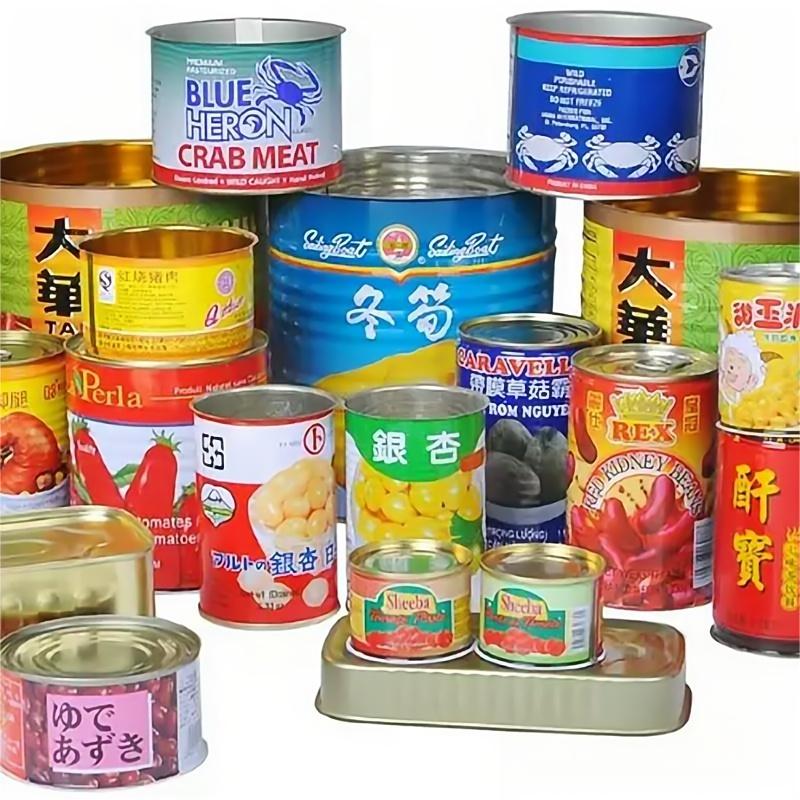
Custom Metal Food Cans for OEM Orders
|
Customization Item |
Available Options & Specifications |
|
Can Dimensions & Shape |
Custom diameter, height, capacity and shape; non-standard sizes subject to tooling evaluation and MOQ. |
|
Can Structure |
Three-piece or other available can structures; body, bottom and top-end configurations. |
|
Material & Thickness |
Tinplate, TFS and applicable aluminum; material grade and thickness based on forming, coating and end-use requirements. |
|
Internal Coating |
Epoxy-phenolic, BPANI, polyester and other applicable food-contact lacquers, selected according to food composition and processing conditions. |
|
Exterior Printing |
CMYK offset printing, spot colors, custom artwork, brand graphics and private-label designs. |
|
Surface Finishes |
Matte, gloss and gold-lacquered finishes, with food-grade exterior varnishes where applicable. |
|
Embossing & Debossing |
Raised or recessed logos, batch numbers and recycling symbols on can bodies, lids or bottoms, subject to structural evaluation. |
|
Opening & Closure |
Easy-open ends, plain ends, pull-tab options and compatible can-end profiles. |
|
Tooling Development |
Modification of existing tooling for custom heights, capacities and dimensions; new tooling subject to technical and MOQ assessment. |
|
Prototype & Sample Testing |
Plain or printed samples for dimensional checks, seaming trials, thermal processing and transit drop tests before mass production. |
Manufacturing & Quality Control
Raw Material Testing
Inspect incoming tinplate and TFS (Tin Free Steel) coils for thickness tolerance, tin coating weight consistency (e.g., #25, #50), and mechanical yield strength.
Automated Leak Detection
Pass completed cans through high-pressure air testers or optical pinhole detection systems to reject micro-cracks or weld flaws inline before packaging.
Retort and Corrosion Simulation
Subject sample cans filled with saline or acidic solutions to accelerated thermal and salt-spray chamber testing to verify coating adhesion and corrosion resistance.
Traceability Systems
Laser-etch production batch codes, shift identifiers, and date stamps onto can bodies or ends to ensure full traceability back to raw material coils.
Wholesale Supply, Compliance & Export Support
Regulatory Compliance
Supply food-contact compliance documentation conforming to FDA (US), EFSA (EU) regulations, and GB standards for metal packaging materials.
Packaging and Palletization
Pack cans in clean polyethylene wrap and corrugated divider layers, stacked on heat-treated ISPM 15 wooden or plastic pallets secured with strapping for ocean freight.
Logistics and Minimum Order Quantities (MOQ)
Optimize container space utilization (20GP / 40HQ) based on nested empty can configurations, with clear tier-based MOQ structures for standard and custom sizes.
Documentation Support
Provide complete commercial export documentation including Certificates of Origin, Mill Test Reports (MTR), Bill of Lading, and Packing Lists for smooth customs clearance.
FAQ
As one of the most experienced metal food packaging manufacturers and suppliers in China, we also support customized service. Please feel free to buy high-grade metal food packaging made in China here from our factory. Quality products and reasonable price are available.